
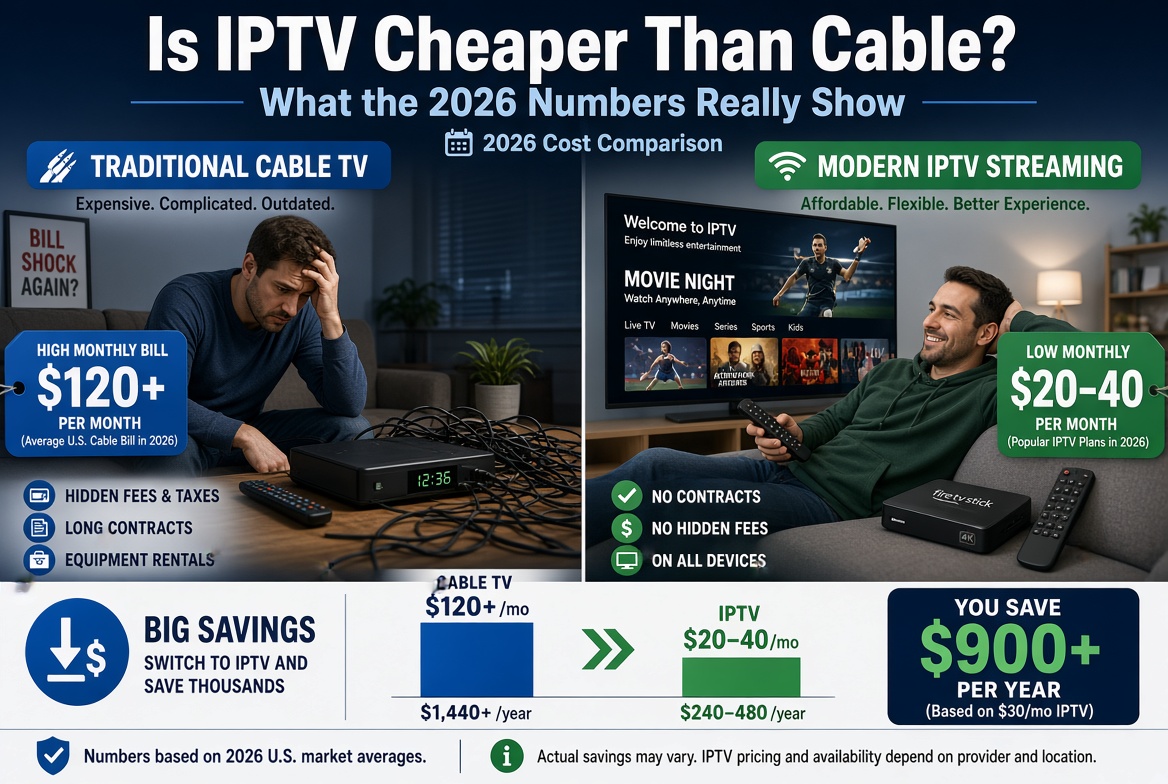
Is IPTV cheaper than cable? In many cases, yes—but the answer is more complicated than comparing two monthly subscription prices. The real cost of television depends on what you watch, how many services you subscribe to, whether you already pay for internet, and how much of your cable package you actually use. In 2026, streaming and internet-delivered television can provide substantial savings, but those savings can shrink when households accumulate multiple subscriptions.
IPTV, Streaming and Cable Are Not Exactly the Same Thing
Before comparing prices, it helps to clear up some terminology.
Streaming describes how video is delivered to you. When you watch Netflix, Amazon Prime Video, YouTube TV or another internet-based television service, the content is delivered through an internet connection.
Cable television, traditionally, delivers television through a cable network, commonly using coaxial infrastructure connected to a set-top box or other receiver. Cable television developed partly because over-the-air broadcast signals could not reliably reach every household.
IPTV, or Internet Protocol Television, refers to television delivered using Internet Protocol networks. The term is often used broadly online for internet-based television services, although technically there is a distinction between managed IPTV delivered over an operator’s network and OTT streaming services delivered over the public internet.
For consumers, however, the practical question is usually simpler:
Which option gives me the television I actually watch for the lowest overall cost?
That is where the comparison becomes interesting.
Is IPTV Cheaper Than Cable in 2026?
For many households, internet-based television can be considerably cheaper than traditional cable—but not automatically.
A 2026 industry report from CableTV.com puts the average cable television bill at around $147 per month, compared with roughly $30 per month for streaming bills. The report also found that cost was the leading reason people cancelled television services.
That does not mean every household can replace a $147 cable bill with a $30 streaming bill and receive exactly the same programming.
The comparison depends on what you are trying to replace.
A household that mainly watches Netflix, a few entertainment channels and occasional free services may spend dramatically less by moving away from cable.
A household that wants live sports, local channels, premium entertainment and several exclusive services could end up paying considerably more.
The Subscription Creep Problem
This is where the original promise of streaming becomes less straightforward.
One streaming service may be inexpensive. Several are still manageable. But once a household starts subscribing to Netflix, Disney+, Max, Prime Video, sports services, live-TV platforms and other niche services, the monthly total can climb quickly.
For example, Netflix’s current U.S. plans range from $8.99 per month for its ad-supported plan to $26.99 for Premium.
Live television streaming can also be significantly more expensive than basic on-demand streaming. YouTube TV’s main plan is currently listed at $82.99 per month after its promotional period and includes more than 100 channels.
So the question isn’t simply:
“Is streaming cheap?”
The better question is:
“How much television do I actually need?”
Why Cable Can Become More Expensive
Traditional cable has one major advantage that is easy to overlook: bundling.
Instead of paying separately for dozens of individual services, a cable package can provide a large collection of channels under one subscription.
The problem is that the customer may also be paying for a large amount of programming they never watch.
This is one reason channel count can be misleading.
A package advertising hundreds of channels sounds impressive, but if a household regularly watches only a small fraction of them, the additional channels do not necessarily provide additional value.
Cable can also involve equipment and service-related charges. Modern streaming television services often compete directly on this point by emphasizing the absence of installation charges, cable boxes and certain equipment fees. YouTube TV, for example, specifically promotes its lack of cable-box, installation, DVR and cancellation fees.
You’re Often Paying for Convenience, Not Just Channels
The traditional cable model bundles infrastructure, equipment, channel packages and customer service into one television bill.
That convenience has value.
But it also means consumers have less control over exactly what they pay for.
Internet television changes that model. You can choose an on-demand service, a live-TV streaming service, free television, an IPTV service, or a combination of several options.
That flexibility is one of the biggest reasons cord-cutting became attractive. If you are exploring different ways to watch on a television, guides such as Best IPTV Apps for Firestick and Best IPTV Apps for Smart TVs can help you understand the device and app side of the setup.
When IPTV Can Be Cheaper Than Cable
The strongest savings usually appear when a household already has reliable internet.
If internet access is already required for work, phones, gaming and other online activities, switching from cable television to internet-delivered television doesn’t necessarily mean adding an entirely new household expense.
Instead, television becomes another service running over the connection you already have.
This can make the comparison much more favorable.
Consider three households.
Household 1: The Minimal Viewer
This household watches a limited selection of movies, series and free online content.
It may need only one or two subscriptions.
For this viewer, internet-based television can be substantially cheaper than maintaining a traditional cable package.
Household 2: The Sports Fan
This household wants live football, basketball, motorsports and other events.
The calculation changes.
Live sports rights are expensive, and specialized sports packages can quickly increase the monthly bill. A live-TV streaming service may still be cheaper than a particular cable package, but the difference may not be dramatic.
YouTube TV’s sports-focused plan, for example, is currently listed at $64.99 per month after its promotional period.
This illustrates why simply saying “streaming is cheap” is misleading. If sports are your main priority, it is worth comparing the full cost of each option, including the channels and events you actually need. Our guide to the best IPTV options for sports streaming in 2026 provides another starting point for that comparison.
Household 3: The Subscription Collector
This household subscribes to almost everything.
Netflix.
Disney+.
Prime Video.
Max.
Sports services.
Specialty channels.
Live-TV streaming.
At that point, the household may recreate the cable problem in a different form.
Instead of one large cable bill, it has multiple smaller bills.
The total can eventually become surprisingly high.
Is IPTV Cheaper Than Cable When You Compare Total Value?
This is arguably the more important question.
Price per month is only one part of the calculation.
Consumers should also consider:
- Number of channels
- Live television availability
- Sports coverage
- Movies and series
- On-demand libraries
- Number of supported devices
- Simultaneous streams
- DVR or catch-up features
- Equipment requirements
- Installation fees
- Contract requirements
- Cancellation flexibility
- Internet requirements
- Advertising
- Reliability and customer support
A cheaper service that constantly buffers or lacks the programming you want may provide worse value than a more expensive service that works reliably.
Likewise, a cable package costing substantially more may not be good value if most of its channels go unused.
Features such as electronic program guides and catch-up viewing can also affect the overall experience. For viewers who want more flexibility around live programming, our guide to EPG and catch-up TV for the FIFA World Cup 2026 explains why these features can matter when comparing services.
The Hidden Cost of Streaming
There is another important issue that often gets ignored in discussions about cord-cutting: internet access.
Streaming requires a suitable internet connection.
If someone already pays for broadband, the incremental cost of streaming television may be relatively small.
But if someone is calculating the entire household television setup from scratch, the internet bill needs to be considered.
This is why comparing a cable television bill directly against a streaming subscription can sometimes produce an incomplete answer.
You need to compare the entire setup.
Cable TV + required fees + equipment
versus
Internet + streaming/IPTV services + equipment
That produces a much more meaningful comparison.
Before choosing an internet-based service, it is also sensible to review the provider’s current plans and total monthly cost. You can compare the available RushStreams pricing options as part of that process, while remembering to include your existing internet bill and any required device costs.
The Number of Subscriptions Matters More Than the Number of Channels
One of the strongest lessons from the changing television market is that consumers don’t necessarily need more content—they need the right content.
A household might pay for hundreds of cable channels but regularly watch only ten.
Another household might subscribe to five streaming platforms but use only two regularly.
In both situations, the problem is the same: paying for content that isn’t being consumed.
The most cost-effective television setup is therefore not necessarily the one with the lowest advertised monthly price.
It is the one that minimizes unused spending.
IPTV vs Cable: Which One Makes More Sense?
For a consumer deciding between the two, the answer depends on priorities.
| Factor | Cable TV | Internet-based TV/IPTV |
|---|---|---|
| Delivery | Cable network | Internet/IP network |
| Equipment | Often provider equipment | Usually compatible smart TV/device |
| Channel flexibility | Often bundled | Depends on service |
| Contract | May apply | Often more flexible |
| Internet required | Not necessarily for traditional TV | Yes |
| Multiple devices | Depends on package | Often a major advantage |
| On-demand viewing | Available on many modern systems | Common |
| Monthly cost | Can be relatively high | Can range from very low to expensive |
| Best for | Traditional all-in-one TV packages | Flexible, internet-based viewing |
The table reveals something important.
There is no universal winner.
Cable may suit viewers who want a single traditional package with familiar support and a broad channel lineup. Internet-based television may suit viewers who prefer flexible subscriptions, multi-device access and more control over what they pay for.
So, Is IPTV Cheaper Than Cable?
Is IPTV cheaper than cable? For many consumers, it can be—but the savings come from choosing television more efficiently, not simply from replacing one technology with another.
A household that pays for one or two carefully selected services may spend far less than a traditional cable customer.
A household that subscribes to every available streaming platform may eliminate much of that advantage.
And a household that needs extensive live sports coverage may find that a premium streaming television service costs considerably more than basic on-demand streaming.
The biggest financial advantage of internet-based television is therefore flexibility.
You can choose what you actually use rather than automatically paying for an enormous bundle.
That is also why the idea of “streaming is always cheaper” has become less convincing in recent years. Subscription prices have increased, and services increasingly use different tiers, advertisements, bundles and add-ons. Recent industry analysis has also found continued subscription price increases across major streaming platforms.
The Bottom Line
The old television model asked consumers to buy a large package and accept whatever came with it.
The modern model gives consumers more choice—but more choice also creates more opportunities to overspend.
So, is IPTV cheaper than cable?
Often, yes.
But the smartest comparison isn’t IPTV versus cable based on a single monthly price.
It is what you pay versus what you actually watch.
If you already have reliable internet and choose your services carefully, internet-based television can offer significant savings, greater flexibility and access across multiple devices.
If you subscribe to every service available simply because you don’t want to miss anything, those savings can disappear.
The winning strategy in 2026 isn’t necessarily choosing the cheapest television service.
It’s building the smallest television setup that gives you everything you actually want to watch.
Final Thoughts
IPTV can be cheaper than cable, but it is not automatically the cheaper choice for every household. The biggest savings usually come from avoiding unused channels, limiting the number of subscriptions you maintain and choosing a service that matches your actual viewing habits.
Before switching, write down the channels, sports, shows and features you use most often. Then compare the complete monthly cost of cable with the combined cost of internet, IPTV or streaming services, devices and any add-ons.
If the internet-based option gives you the content and reliability you need for less money, switching may make sense. If the difference is small, cable’s convenience and bundled support may still be valuable.
The best television setup is not the one with the most channels or the lowest advertised price. It is the one that delivers the content you want without making you pay for services you rarely use.